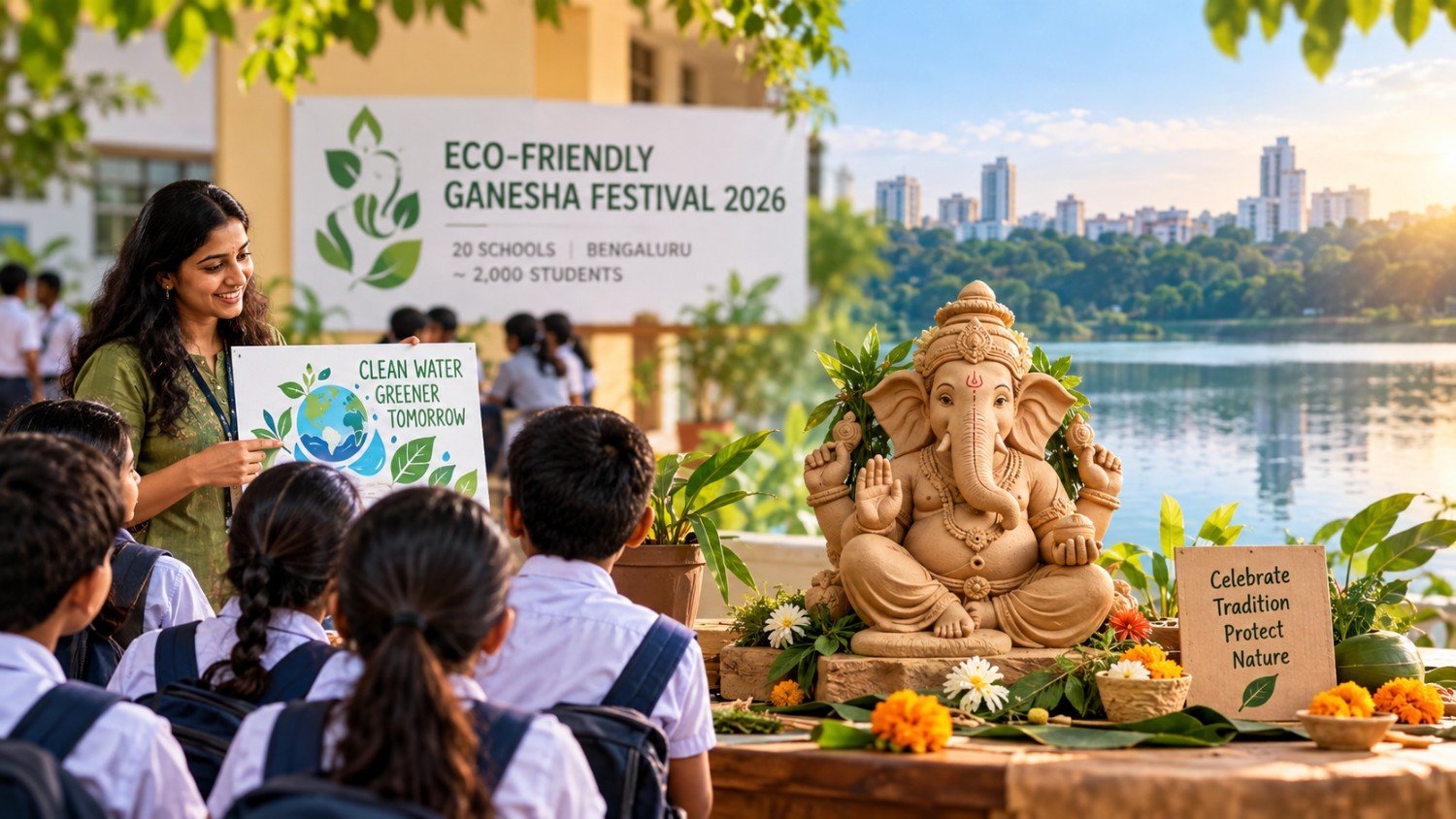
Eco-Friendly Ganesha Festival 2026: How Varuna is Greening Ganesh Chaturthi Across 20 Bengaluru Schools
Discover how Varuna is promoting eco-friendly Ganesh Chaturthi across 20 Bengaluru schools, reaching 2,000 students with a message to protect water and nature.
Ganesh Chaturthi is a festival deeply rooted in faith, tradition and community. But as celebrations grow, so does the responsibility to think about what happens after the festivities end.
For Varuna, that question naturally comes back to one thing: water.
As a company working in sewage and wastewater treatment, we see how difficult it can be to restore water quality once pollution enters the system. That is why, this Ganesh Chaturthi, we wanted to take a different approach — not simply talk about environmental responsibility after the problem occurs, but encourage better choices before it begins.
That idea led to the Eco-Friendly Ganesha Festival 2026, an awareness initiative being taken to 20 schools across Bengaluru and around 2,000 students, in collaboration with PCB.
The objective is simple: help young people understand that celebrating Ganesha and protecting nature do not have to be two separate things.
Why an Eco-Friendly Ganesh Chaturthi Matters
Ganesh Chaturthi celebrations can create significant environmental pressure, particularly around idol immersion.
Materials used to make idols, paints, decorations and other festival waste can ultimately find their way into water bodies when celebrations are not planned responsibly. Bengaluru, with its network of lakes and other water resources, has an especially important reason to keep this conversation going.
One of the simplest choices is the material used for the idol.
Choosing a clay or other eco-friendly Ganesha idol can be a more responsible alternative to idols made with materials that are difficult to break down in water. Similarly, reducing unnecessary waste and avoiding polluting materials can help make the celebration kinder to the environment.
These may seem like small decisions.
But when thousands of households make better choices together, those small decisions can have a much larger impact.
Why We Chose Schools
If we wanted this campaign to create awareness beyond a single festival season, we needed to reach people who could carry the message forward.
That is why schools became an important part of the initiative.
Students are naturally curious. When environmental ideas are introduced in a simple and engaging way, they can take those conversations beyond the classroom — to their friends, parents and communities.
Instead of making the campaign heavily technical, we focused on practical ideas that students could understand and act upon:
- Why eco-friendly Ganesha idols matter
- How celebrations can affect water bodies
- Ways to reduce waste during festivals
- Why responsible immersion is important
- How individual choices can contribute to environmental protection
The goal isn't to make students environmental experts.
It is to give them one simple thought they can take home:
“Can we celebrate differently this year?”
Taking the Green Ganesha Message to 20 Schools
The campaign is designed as a series of awareness activities leading up to the festival.
The conversation begins with the larger idea of celebrating Ganesh Chaturthi responsibly. It then moves towards specific actions — protecting water bodies, choosing eco-friendly idols and reducing waste.
Students also get an opportunity to participate and share their own thoughts about protecting nature.
That participation is important.
Instead of making environmental awareness a one-way lecture, the campaign gives students space to think, respond and communicate the message in their own way.
Across 20 Bengaluru schools and approximately 2,000 students, the initiative aims to turn environmental awareness into something practical and relatable.
We Are Not Asking Anyone to Stop Celebrating
Environmental responsibility should not mean giving up traditions.
That is not the message behind this campaign.
Ganesh Chaturthi is about devotion, community and celebration. Our message is simply that these values can coexist with greater care for nature.
Choose an eco-friendly idol.
Reduce unnecessary waste.
Avoid polluting materials.
Think about where the idol will be immersed.
Be mindful of the water bodies around us.
None of these choices takes away from the spirit of the festival.
Instead, they add another dimension to it — celebrating with responsibility.
Why Water Is at the Centre of the Conversation
For Varuna, this campaign is closely connected to the work we do throughout the year.
Wastewater treatment is ultimately about protecting one of our most valuable natural resources: water.
Whether it is sewage, industrial effluent or other forms of wastewater, treatment becomes necessary because pollution does not simply disappear. It has to be managed responsibly.
The same thinking applies during festivals.
Prevention is better than trying to address the consequences later.
That is why we believe environmental awareness should not begin after a water body has already been affected. It should begin with the choices we make before the celebration starts.
A Small Change Can Start a Bigger Conversation
One campaign cannot solve Bengaluru's environmental challenges.
We know that.
But that does not mean the conversation isn't worth starting.
If 2,000 students learn why eco-friendly celebrations matter, share that knowledge with their families and carry those habits into future celebrations, the impact can extend well beyond the two-day event.
That is what makes awareness valuable.
It doesn't end when the posters come down or when the festival is over.
It stays with people.
Celebrating Tradition. Protecting Nature.
The Eco-Friendly Ganesha Festival 2026 is our way of bringing two important ideas together: respect for tradition and responsibility towards the environment.
This Ganesh Chaturthi, as the celebrations begin across Bengaluru, we hope more families pause for a moment and think about one simple question:
What can we do differently this year?
Because celebrating responsibly does not mean celebrating less.
It means celebrating with greater awareness.
Celebrate Tradition. Protect Nature.